

















75th Anniversary of D-Day Student/Teacher Tour
A D-Day student tour gives history classes the opportunity to study the Normandy invasion where it happened. Beaches, bunkers, museums, memorials, and cemeteries make the scale and human consequences of Operation Overlord easier to understand. The sites where that happened are still there, largely preserved.
Visiting them with students is one of the most effective ways to make the history of WWII real in a way that a classroom cannot replicate. A D-Day Normandy student trip delivers a history lesson that no classroom can replicate.
Why a D-Day Student Tour Changes the History Lesson
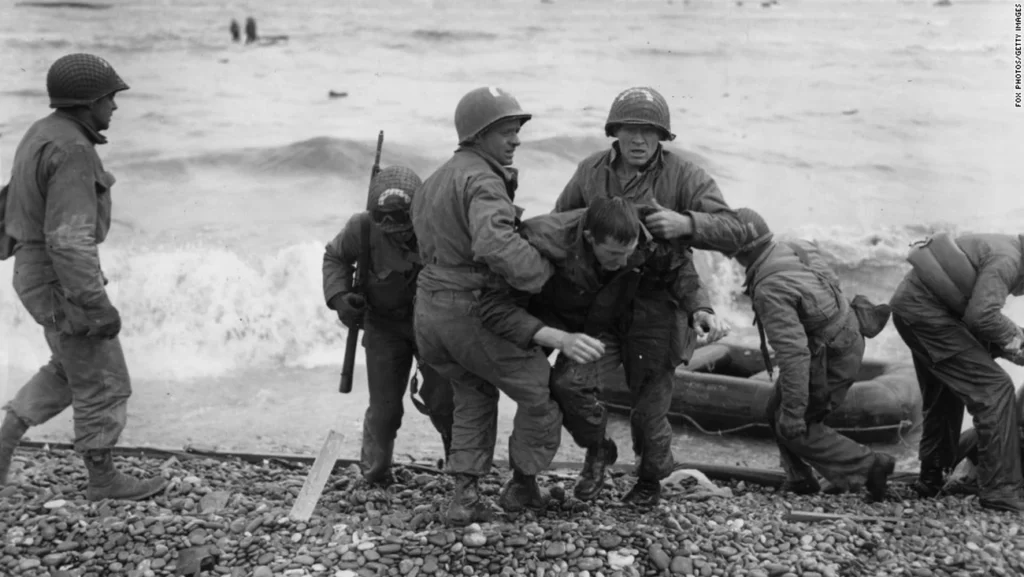
Operation Overlord, as the invasion was code-named, involved nine Allied nations and more than 150. 000 troops assembled on the Normandy coast. More than 23,000 paratroopers from the United States and Great Britain were dropped by aircraft and gliders in the hours before dawn. Over 5,000 ships supported the amphibious assault.
The five landing beaches were code-named Utah, Omaha, Gold, Juno. Sword. By nightfall on June 6, the Allies had established a foothold on the coast. Within five days, a further 326,000 troops, 54,000 vehicles, and 104,000 tons of supplies had arrived to support the operation.
The liberation of Western Europe from Nazi Germany had begun. For students studying WWII, the scale of the operation is difficult to grasp from a textbook. Standing on Omaha Beach, looking up at the bluffs where German positions were entrenched. Then walking through the American Cemetery behind the beach, makes the cost of those hours concrete and permanent in a way that statistics do not.
The Key Sites
The Normandy American Cemetery and Memorial
The Normandy American Cemetery at Colleville-sur-Mer overlooks Omaha Beach and holds the graves of 9. 388 American military dead, most of whom lost their lives in the D-Day landings or in subsequent operations. The cemetery operates under by the American Battle Monuments Commission and is one of the most visited American cemeteries in the world.
The visitor centre provides a comprehensive account of the D-Day landings through maps, photographs. Personal testimonies. The cemetery itself. Its rows of white marble crosses and Stars of David extending to the horizon above the beach. Is among the most affecting sites in Europe.
Pointe du Hoc
Pointe du Hoc is a cliff headland that was one of the most heavily fortified German positions on the Normandy coast. On the morning of June 6, the 2nd Ranger Battalion scaled the 30-metre cliffs under fire using ropes and ladders to destroy the artillery battery positioned there. The site has been preserved almost exactly as it was left in 1944.
The bomb craters, the reinforced concrete bunkers, the cliff edge. Walking through it gives students a physical understanding of the operation that no photograph conveys. It is also one of the sites where the terrain itself is the most eloquent teacher.
Utah Beach and the Utah Beach Museum
Utah Beach, the westernmost of the five landing beaches, saw the most successful of the D-Day landings in terms of casualties. The 4th Infantry Division landed with fewer losses than anticipated. Partly due to a navigational error that placed them 2 kilometres south of their intended position.
The Utah Beach Museum covers the landings in detail and includes a B-26 Marauder bomber, landing craft. Sherman tanks among its exhibits. The beach itself is accessible and gives students a direct view of the terrain the troops crossed on June 6.
The Mémorial de Caen
The Mémorial de Caen is the most comprehensive WWII museum in Normandy, covering the causes of the war. The occupation, the resistance, the liberation. The Cold War that followed. For history teachers covering the full arc of 20th century conflict, it is the most coherent single museum experience in the region.
The memorial is built over a German command bunker used during the Battle of Normandy. The architecture intentionally marks the rupture in European history that WWII represents. Our France: D-Day and USA Tour includes the Mémorial de Caen as a core component of the itinerary.
Dieppe and the Raid of 1942
The Dieppe Raid of August 19, 1942, in which predominantly Canadian forces attempted an amphibious assault on the port of Dieppe, resulted in catastrophic losses. Of the 6,086 soldiers who crossed the Channel, 3,623 died, wounded, or captured. For Canadian history teachers, Dieppe is a significant curriculum point.
The beaches and memorials at Dieppe carry a weight that connects directly to the Canadian experience of WWII. The lessons learned from Dieppe also directly informed the planning of the D-Day landings two years later.
Curriculum Connections
A Normandy trip connects directly to secondary history curricula covering the causes and course of WWII. Allied strategy, the Holocaust (the liberation of concentration camps followed D-Day), the role of Canada, the United States. Britain in the Allied effort. The post-war construction of Europe. For French language teachers, Normandy also offers a French-language context for the history.
The local guides speak French, the museums offer French-language materials. The relationship between the Norman civilian population and the Allied forces is a history worth exploring in the language of those civilians.
Prométour has designed D-Day and Normandy itineraries for history and French language teachers for over three decades. OurFrance: D-Day and USA Tourand France: Cultural Tour can both be customised to include Normandy, the American Cemetery. The key memorial sites. Every tour is private, fully custom, and built around your programme. For teachers planning a d-day normandy student trip history, the curriculum connections and logistical support available make this one of the most rewarding programmes to build.