

















FranceArt & ArchitectureMusicOctober 10, 2018 | 5 min read
A Ghost at the Garnier Opera House of Paris?
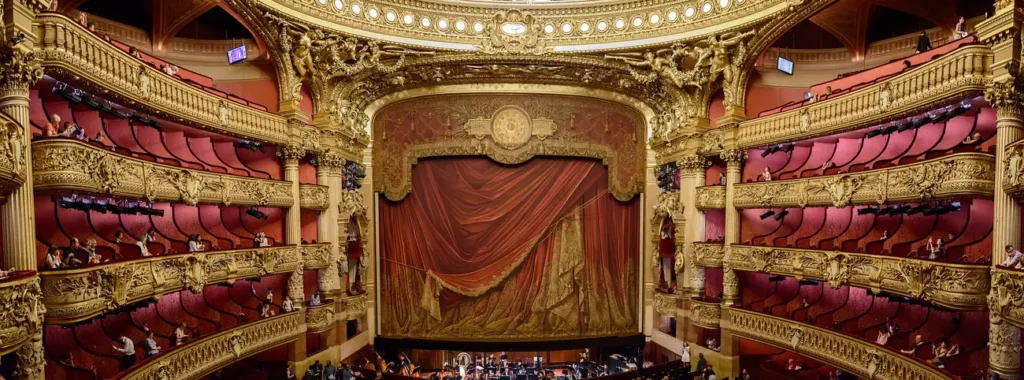
A Garnier Opera House student visit connects architecture, music, theatre, French history, and one of Paris’s most famous literary legends. The Palais Garnier offers several curriculum entry points within a single building. Is one of the most architecturally significant buildings in France and the inspiration for one of the most enduring works of French popular fiction.
For art history teachers, music teachers. French language teachers, it offers a site where curriculum connections arrive from several directions at once. The Garnier Opera House in Paris is one of the most versatile student trip destinations in the city for art history. Music, and French language teachers.
Why a Garnier Opera House Student Visit Works
The Palais Garnier originated by Emperor Napoleon III in 1861 as part of Baron Haussmann’s transformation of Paris. The architect Charles Garnier won the design competition with a proposal in the Neo-Baroque style that was. At the time, unlike anything Paris had seen. The building took fourteen years to complete, partly because the discovery of an underground water table during excavation required the construction of an enormous concrete cistern beneath the foundations. That cistern.
Remains today, holds water and served as by Parisian firefighters for decades as a training facility. It is also, as Gaston Leroux noted in the prologue to his 1910 novel. The lake beneath the opera house where the Phantom makes his home. The interior of the Garnier is among the most opulent in France.
The Grand Staircase in white marble, the ceiling of the main auditorium painted by Marc Chagall in 1964. The Grand Foyer modelled on the Hall of Mirrors at Versailles, and the building’s extraordinary chandelier. Weighs over six tonnes, are each worth extended discussion in the context of 19th-century French architectural and decorative arts. For art history students, the Garnier is a primary source for the aesthetic ambitions of the Second Empire.
The Chandelier Incident and the Origins of the Phantom
On May 20, 1896, a counterweight holding one of the chandelier’s anchoring cables broke loose. Causing part of the chandelier to fall into the audience during a performance. One person died. The incident joined a growing collection of rumours and unexplained events surrounding the opera house. Including reports of a mysterious figure seen in the upper galleries.
The discovery of a skeleton in one of the building’s underground passages during renovation work in the early 20th century. These were the raw materials Gaston Leroux assembled intoLe Fantôme de l’Opéra.
First published in serial form inLe Gauloisin 1909 and 1910.
Gaston Leroux andLe Fantôme de l’Opéra
Gaston Leroux was a journalist and crime novelist whose earlier work, includingLe Mystère de la chambre jaune.
Had established him as one of the founders of the French detective fiction genre. His Phantom novel opens with the claim. “The Opera ghost really existed.” Whether this is a journalistic instinct, a literary conceit. Or something in between is itself a productive question for French language students to explore.
The novel’s plot, involving a disfigured musical genius who lives beneath the opera house, terrorises the staff. Becomes obsessed with a young soprano named Christine Daaé, blends Gothic romance with mystery fiction in a way that was enormously influential. The 1986 Andrew Lloyd Webber musical has given the story a second global life.
The French novel has a darker, more ambiguous tone that rewards reading in the original language. Our France: Cultural Tour includes time in Paris and can incorporate a visit to the Palais Garnier.
Classroom Activity: Comics and Stories
A productive classroom activity before or after visiting the Garnier is to introduce students to two or three of the building’s most documented mysteries. The underground lake, the chandelier incident, and the skeleton found during renovations. After a discussion of where fact meets fiction in Leroux’s novel.
Students can create their own short comics or stories about the opera ghost. Set in the building they have now visited or are about to visit. For French language teachers, the activity works well in the target language. The visual format of comics allows students to communicate narrative even at lower proficiency levels.
The exercise connects literature, history, and creative writing in a single task. The Garnier provides a physical setting that makes the fictional world of the Phantom feel less remote than it does from a classroom in North America.
Practical Information for Visiting Groups
The Palais Garnier offers guided tours in French and English for school groups and is accessible from the Opéra metro station on lines 3, 7, and 8. Group tours must be booked in advance. The calendar for performances and private events can affect public access on specific dates.
The Bibliothèque-musée de l’Opéra, housed within the building, holds an extraordinary collection of set designs, costumes, scores. Documentation of the Garnier’s history, and is open to visitors as part of the guided tour. For music teachers, attending a performance at the Garnier. Now hosts ballet rather than opera (the Opéra Bastille took over the main opera programme in 1989). Is an experience that connects the curriculum to the building in the most direct way possible.
Prométour builds fully private, custom school group tours to France for art history, music, and French language programmes. The Palais Garnier can be included as part of a Paris itinerary alongside the Louvre, the Musée d’Orsay. Other key sites. Browse ourFrance: Cultural Touror France: Art Tour to see what a customised itinerary could look like. The curriculum connections and logistical support available make this one of the most rewarding programmes to build.