
















Did you know? How You Can Step on American Soil while in France
American history sites in France give students a powerful way to examine the country’s role in European conflicts and the memory of those who served abroad. Military cemeteries and memorials make that shared history visible. The Normandy American Cemetery and Memorial at Colleville-sur-Mer is a United States territory within France.
The land received to the United States by France in perpetuity, the American flag flies over it. It is administered by the American Battle Monuments Commission (ABMC), a small agency of the executive branch of the U.S. federal government. For history teachers planning a trip to France, it is one of the most important sites in Europe. The Normandy American Cemetery is US territory within France and one of the most important history student trip destinations in Europe.
Why American History Sites in France Matter
The Normandy American Cemetery occupies 172 acres in the French commune of Colleville-sur-Mer, overlooking Omaha Beach. France granted the United States a perpetual concession to the land on June 8. 1944, two days after the D-Day landings, making it one of the earliest acts of the postwar Franco-American relationship and a legal arrangement that has remained in force ever since.
The American flag flies over the cemetery, the staff are Americans. The land falls under U.S. federal regulations. Visitors entering the cemetery cross into American territory without passing through any customs or border formality. Is itself a useful starting point for a discussion about how international law and diplomatic agreements create enclaves of sovereignty within another country’s borders.
The Cemetery
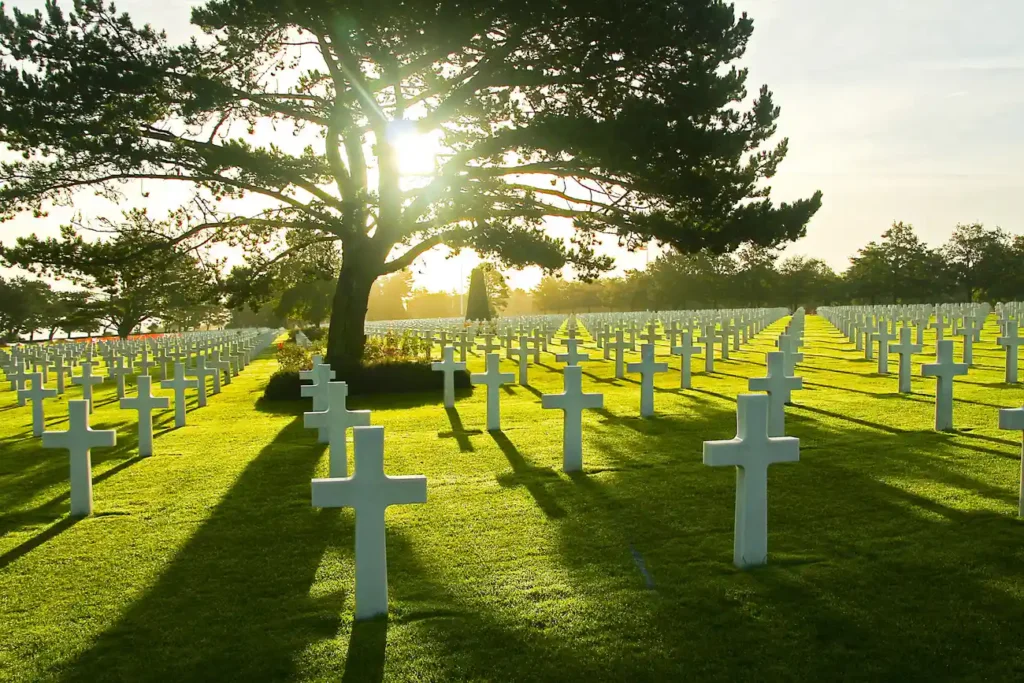
The cemetery is the resting place of 9,385 American military personnel. The majority of whom died in the D-Day landings of June 6. 1944, or in the subsequent Battle of Normandy. The graves are marked by white marble crosses and Stars of David arranged in geometrically precise rows across 172 acres of immaculately maintained grounds above Omaha Beach.
The memorial at the eastern end of the cemetery includes a bronze statue representing the spirit of American youth. A reflecting pool, a chapel. Carved maps of the D-Day operations. The Wall of the Missing, inscribed with the names of 1,557 soldiers whose remains were never found.
Lines the hemicycle at the western end. Students who visit the cemetery often describe it as the most affecting experience of any trip to Europe. Teachers consistently note that the quality of student attention at the site is different from anything they observe at other historical sites.
Omaha Beach
Directly below the cemetery, the stretch of beach code-named Omaha by Allied planners on June 6. 1944, saw the highest casualty rate of the five D-Day landing beaches. The U.S. 1st and 29th Infantry Divisions landed on Omaha against heavily fortified German positions on the bluffs above.
The terrain, a wide, exposed beach with no cover and 50-metre bluffs commanding the approaches, made the landing extraordinarily costly. Approximately 2,000 American soldiers died or wounded on Omaha Beach on June 6 alone. Walking the beach and then looking up at the bluffs. Then climbing to the cemetery above, gives students a spatial experience of the operation that no map or photograph can replicate. The scale of the distance and the angle of the terrain become physically real in a way that changes how students understand what happened there.
The Visitor Centre
The visitor centre at the Normandy American Cemetery, opened in 2007, provides a comprehensive account of the D-Day landings through photographs. Maps, personal testimonies, and artefacts. The exhibition covers the planning of Operation Overlord, the experiences of individual soldiers. The tactical situation on each of the five beaches.
The strategic significance of the invasion for the outcome of the war in Europe. For teachers whose students have varying levels of prior knowledge about WWII. The visitor centre provides a baseline that allows the cemetery and the beach visit that follows to be understood in context.
The centre also includes a database of all the individuals buried or commemorated at the cemetery. Allows students to look up specific soldiers by name, state, or unit. Our France: D-Day and USA Tour includes the cemetery and visitor centre as a core component.
Practical Information for School Groups
The Normandy American Cemetery is open to visitors year-round, with the exception of Thanksgiving and Christmas Day. From 9:00 a.m. to 5:00 p.m. (extended hours in summer). Admission is free. School groups are welcomed and the ABMC provides educational materials and, by advance arrangement, guided programmes for student groups.
The cemetery sits approximately 15 kilometres west of Bayeux and 30 kilometres from Caen. Making it accessible as a day trip from either city or from Paris with an early start. Dress code for the visit is respectful. Students should be briefed before arrival about the nature of the site and the behaviour expected of them.
For many student groups, the Normandy American Cemetery is the first time they have visited a military cemetery of any kind. The preparation the teacher does before the visit is part of what determines the quality of what students experience there.
Connecting It to the Curriculum
A visit to the Normandy American Cemetery connects directly to secondary history curricula covering WWII. The Allied liberation of Western Europe, the Franco-American relationship. The role of the United States in international affairs. For social studies teachers covering how the United States exercises influence through diplomatic, legal.
Military means, the legal status of the cemetery is itself a curriculum topic. For students of any age who need to understand why the D-Day landings mattered. Standing on the bluff above Omaha Beach and counting the rows of crosses extending to the tree line at the edge of the cemetery is the most direct answer available.
Prométour includes the Normandy American Cemetery as part of its dedicated France history itineraries. OurFrance: D-Day and USA Tourand France: Cultural Tour can both be customised to include the cemetery. Omaha Beach, Pointe du Hoc. Other D-Day memorial sites. Every tour is private and built around your history programme. For teachers planning a normandy american cemetery student trip, the curriculum connections and logistical support available make this one of the most rewarding programmes to build.