








Pointe-à-Callière: Montréal History Beneath the City
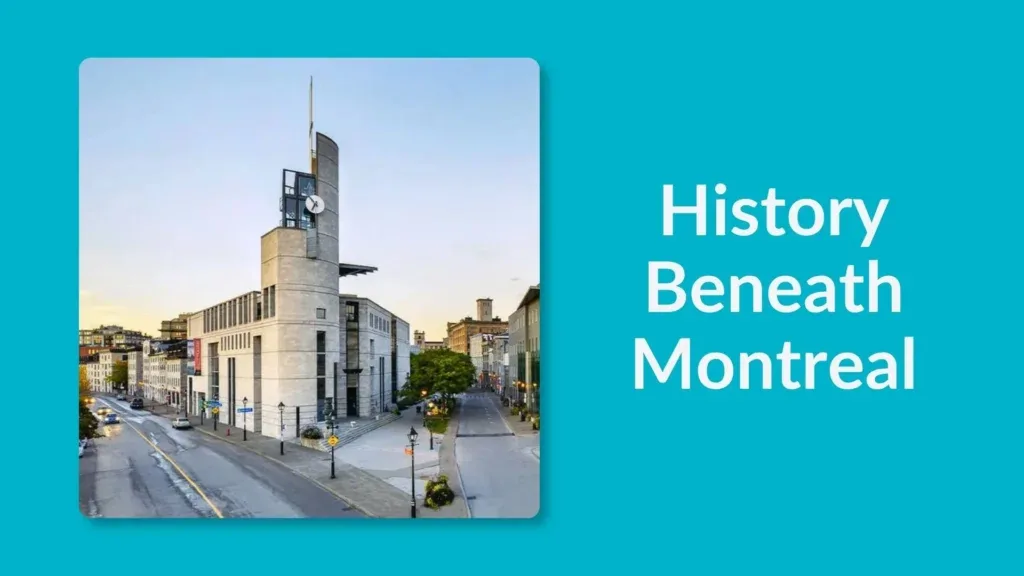
A Pointe-à-Callière student visit allows learners to explore Montréal through archaeological remains, artifacts, maps, multimedia interpretation, and the physical layers beneath the city. The museum stands near the place where Ville-Marie was founded in 1642, making it a strong setting for examining how historians reconstruct the past and how cities preserve, reinterpret, or build over earlier communities.
Quick answer: Prométour plans private, custom student trips in Québec that are built around one class and one set of learning goals, so the itinerary, group size, and academic focus fit what a teacher actually needs.
Pointe-a-calliere student visit gives teachers a focused way to connect curriculum goals with authentic experience. A Pointe-à-Callière student visit allows learners to explore Montréal through archaeological remains, artifacts, maps, multimedia interpretation, and the physical layers beneath the city. The museum stands near the place where Ville-Marie was founded in 1642, making it a strong setting for examining how historians reconstruct the past and how cities preserve, reinterpret, or build over earlier communities.
Archaeology makes historical reasoning visible
Students can see that history is not produced from one kind of source. Foundations, streets, objects, written accounts, and environmental evidence contribute different pieces of information.
Teachers can ask students to distinguish observation from interpretation. What is physically present? What conclusion has the museum drawn? What additional evidence would strengthen that conclusion?
The site reveals layers of urban change
The museum’s underground spaces show how shorelines, fortifications, sewers, buildings, and public spaces changed over time. This makes urban development easier to understand because students move through the evidence.
A map comparison activity can connect the archaeological site to contemporary Montréal. Students can identify what has remained, what has disappeared, and why the city expanded in particular directions.
Indigenous presence requires a broader timeline
Montréal’s history did not begin with French settlement. The island had long been part of Indigenous territories and networks. Teachers should frame colonial foundations within that deeper history and recognize the continuing presence of Indigenous peoples.
Museum interpretation can become a starting point for examining which histories are visible, which sources survive, and how institutions update narratives as scholarship and community relationships evolve.
A museum visit can support multiple subjects
History students can study evidence and colonization. Geography students can examine location and urban form. Art students can consider exhibition design, while French learners can work with bilingual interpretation.
Giving small groups different lenses can create a stronger debrief. Each group notices different details and contributes to a more complete understanding of the site.
Archaeology Makes Urban History Visible
A Pointe-a-Calliere student visit allows learners to see that a city is built in layers. Foundations, streets, drainage systems, artefacts, and changing shorelines reveal how Montréal developed and how later construction covered earlier forms of life.
The museum is especially useful for teaching evidence. Students can compare an artefact with an interpretation and ask what conclusions are certain, probable, or still debated.
Connect the Underground Site to the Modern City
After the visit, students can walk through Old Montréal and identify where the buried city continues to influence street patterns and public space. This connection helps them understand archaeology as part of present-day planning and identity rather than a subject concerned only with distant civilizations.
Pointe-à-Callière is most effective when students are asked to investigate evidence and connect the underground site to the living city outside. Quebec: Montreal Urban Geography Tour offers a practical starting point, and the Montréal educational tours page can help you compare related options.
Archaeology Turns the City Into Evidence
Pointe-à-Callière helps students understand that urban history is physically layered. Foundations, streets, objects, and infrastructure show how the city changed through settlement, trade, conflict, and expansion. Students are not only reading about the past; they are examining traces that survived beneath modern Montréal.
A useful follow-up is to ask what future archaeologists might learn from the students’ own neighbourhood. This comparison makes archaeological interpretation feel less remote and encourages careful thinking about evidence.
Questions Worth Exploring With Students
For teachers, the experience becomes most valuable when students know what evidence to look for and how the experience connects to work already completed in class. A focused question, a short observation task, and a purposeful discussion afterward can turn the topic into learning that students can explain in their own words.
For background research, teachers can consult official sources such as Pointe-à-Callière museum and Parks Canada.
Frequently asked questions
What grade levels are Québec student trips suitable for?
Because Prométour builds every itinerary privately for a single group, the pacing and content are set to match the class, from middle-school groups to senior students. A teacher shapes the academic focus, so the same route can serve a beginner language class or an advanced one.
How far ahead should teachers plan Québec student trips?
Most group leaders start nine to twelve months out, which leaves room to confirm dates, fundraise, and align the route with the curriculum. You can request a custom quote and a draft itinerary early, then adjust it as enrolment settles. See the trip page for a starting point.
Are meals part of the learning, and can dietary needs be met?
Yes. Shared meals are treated as cultural lessons rather than simple stops, and private group planning means dietary restrictions are arranged in advance with local partners.
Bringing it into the classroom: the strongest Québec trips start from a clear curriculum goal, not a checklist of sights. Decide what you want students to understand in your unit, then let the itinerary serve that goal. A private, custom plan makes that alignment possible, and you can shape it directly on the trip page.