


20+ Reasons to Visit Québec with Your Students
A Quebec student trip offers French immersion, Canadian history, distinctive culture, and accessible group travel without crossing the Atlantic. Montréal and Québec City give teachers two complementary learning environments in one itinerary. For history teachers, it is the only walled city north of Mexico City.
For any teacher with a mixed group covering French, history, geography, or art. Québec covers more curriculum ground per day than almost any other destination in North America. There are compelling educational reasons to bring students on a Costa Rica student trip.
Why a Quebec Student Trip Delivers Real Educational Value
1.
Old Québec, a UNESCO World Heritage Site. The only fortified city in North America north of Mexico. Old Québec’s city walls, bastions. Historic gates date to the 17th and 18th centuries. Walking the walls gives students a direct encounter with the military and colonial history of New France in a way that requires very little explanation to be immediately legible.
Prométour’s Ottawa, Montréal and Québec Tour spends dedicated time in Old Québec with a knowledgeable local guide. 2.
La Citadelle. The citadel at the top of Cap Diamant is still an active military installation. Home to the Royal 22e Régiment, the only French-speaking regiment in the Canadian regular army. The daily Changing of the Guard ceremony (June through Labour Day) and the fortress museum give students a layered view of Québec’s military history from New France through both World Wars.
3.
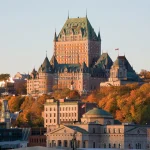
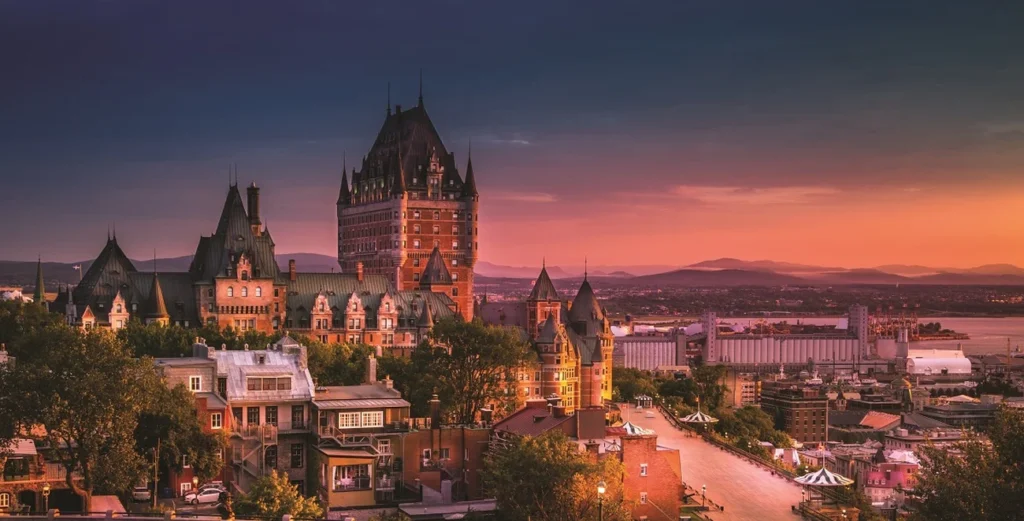
Le Château Frontenac. The most photographed hotel in the world stands above the St. Lawrence on the site of the former residence of the governors of New France. Its architecture is immediately striking, its history is substantive. Its terrace offers one of the best views of the river in the city.
It also served as the site of the 1943 and 1944 Québec Conferences between Churchill and Roosevelt. Gives it a direct curriculum connection for WWII history programmes.
4.
Terrasse Dufferin. The long boardwalk in front of the Château Frontenac follows the cliff above the Lower Town and offers views of the St. Lawrence, the Île d’Orléans. The south shore. In winter, it becomes home to Les Glissades de la Terrasse, a toboggan slide that has been operating since 1884.
5.
Montmorency Falls. At 83 metres, Montmorency Falls is higher than Niagara Falls, a fact students tend to find genuinely surprising. The falls are accessible by cable car or on foot and can be viewed from multiple lookout points. A suspension bridge above the crest. From below.
In winter, ice forms at the base into a large cone called the pain de sucre, which ice climbers ascend on weekends. The site offers a striking example of how Québec’s climate shapes both the landscape and local winter activities.
Carnaval de Québec. Running each February for more than 60 years. The Carnaval de Québec is the largest winter carnival in the world. Events include ice canoe races on the St. Lawrence, ice sculpture competitions, a night parade. The iconic Ice Palace built fresh each year.
For French immersion students, the carnival is a context-rich, linguistically immersive experience that is also, straightforwardly, fun. 7.
Hôtel de Glace. Built fresh each winter from ice and snow. The Hôtel de Glace at the Valcartier resort is a fully functioning hotel. Rooms, a chapel, an ice bar, and sculptures throughout. Rooms reach temperatures of minus five degrees Celsius overnight. For student groups, a visit without an overnight stay offers an encounter with a genuinely unusual architectural and cultural phenomenon.
8.
Village Vacances Valcartier. Adjacent to the Hôtel de Glace, Valcartier is North America’s largest winter theme park. Offering tubing, ice slides, skating on a two-kilometre trail. Indoor water park access. It functions well as a structured leisure afternoon during a Québec City itinerary.
9.
Dog Sledding at Aventure Plein Air Inukshuk. A dog sledding excursion through the Laurentian forests north of Québec City gives students the experience of mushing a team of huskies through boreal forest in winter. The activity connects to Indigenous travel and survival traditions and generates the kind of shared.
Physical, slightly difficult experience that student groups remember as a unit for years afterward. 10.
Aquarium du Québec. The Aquarium du Québec houses walruses, polar bears, stingrays. A wide range of freshwater and saltwater species. Its focus on Arctic and sub-Arctic marine life is unusual among North American aquariums and gives it a natural curriculum connection for biology and environmental science programmes studying northern ecosystems.
11. École de Cirque de Québec. The Québec circus school offers structured workshops for visiting student groups.
Covering juggling, acrobatics, balance work, and aerial skills. The activity is active, participatory. Connects to Québec’s disproportionately large contribution to contemporary circus arts globally. Through Cirque du Soleil and the circus school network that feeds it.
12.
A Sugar Shack (Cabane à sucre). In late winter and early spring.
The maple sugar shacks of the Québec countryside open for the season. A visit to a workingcabane à sucre, watching the sap boiled down to syrup.
Tasting maple taffy poured hot onto snow, eating the traditionaltire d’érable. Is one of the most distinctly Québécois experiences available to student groups.
Montréal
13.
Old Montréal (Le Vieux-Montréal). The historic district along the St.
Lawrence waterfront contains some of the oldest buildings in North America, including the Basilique Notre-Dame de Montréal (1829), the Pointe-à-Callière archaeology museum. The Marché Bonsecours. The neighbourhood is walkable, linguistically French, and visually distinct from anywhere else in North America.
14.
Pointe-à-Callière Museum. Built on the archaeological site of Montréal’s founding, Pointe-à-Callière is one of the most effectively designed history museums in Canada. Students walk through excavated layers of the city’s history, from Indigenous settlement through the French colonial period and into the British era. In an underground circuit beneath the modern city.
15.
Mont Royal. Frederick Law Olmsted, the designer of Central Park in New York, designed Parc du Mont-Royal in 1876. The park sits at the centre of the island of Montréal and offers a panoramic view of the city from the belvedere. The park functions as daily by Montréalers for skiing in winter and cycling and hiking in summer.
The Sunday drum circle, known as thetam-tams, draws crowds in warm weather.
16.
The Underground City (La Ville Souterraine). Montréal’s network of underground pedestrian tunnels connects 41 metro stations.
Hundreds of buildings, shopping centres. Institutions across 33 kilometres of passageways. Developed from the 1960s onward as a response to the city’s winters. It is the largest underground pedestrian network in the world and a productive case study in how climate shapes city design.
17.
The Plateau and Mile End Neighbourhoods. The Plateau-Mont-Royal and Mile End districts give students access to Montréal’s contemporary cultural life. Independent bookshops, murals, cafés, markets, and music venues in a neighbourhood that is linguistically mixed and not oriented toward tourists. For French immersion students, navigating this neighbourhood independently for an afternoon is the closest equivalent to being in France without leaving North America.
18.
Biodôme and Space for Life. The Montréal Biodôme recreates five ecosystems under one roof. Including the tropical rainforest, the Laurentian maple forest. The Sub-Antarctic Islands, using living plants and animals. Adjacent to it are the Botanical Garden, the Insectarium. The Planetarium, all part of the Space for Life complex.
For biology and environmental science groups, the Biodôme and Botanical Garden together provide a full day of structured, curriculum-relevant content. Students can compare ecosystems, examine plant adaptations, and connect classroom concepts with carefully designed living environments.
Marché Jean-Talon. The Jean-Talon Market in the Little Italy neighbourhood is one of the largest open-air markets in North America and one of the most linguistically French public spaces in Montréal. For French immersion students, a morning at the market, navigating in French and buying something.
Is a practical immersion exercise with immediate, tangible results. 20.
Le Café-Graffiti. Café-Graffiti is a community arts and workshop centre in the Rosemont neighbourhood that has been offering workshops to young people since 1994. For student groups, it offers structured half-day workshops in visual art, ceramics, silk-screening. Other disciplines, led by professional artists in a working studio context.
21.
Jazz Festival, Just for Laughs, and Francofolies. Montréal’s festival calendar is among the densest in North America. The Festival International de Jazz de Montréal, running in late June and early July. Features hundreds of free outdoor performances alongside paid concerts. The Francofolies de Montréal celebrate French-language music each August. For groups travelling during summer, a festival provides an evening of authentic cultural participation at no cost.
Prométour is based in Montréal and has been building school group tours across Québec for over three decades. Our tours are private, fully bilingual. Built around your French programme and curriculum.
Explore theOttawa, Montréal and Québec Tour, the Toronto and Niagara Falls Tour. Or the Ottawa, Toronto and Niagara Falls Tour to see how your group could experience la belle province. The curriculum connections and logistical support available make this one of the most rewarding programmes to build.