













Did You Know? Who is Bonhomme?
Bonhomme Quebec Winter Carnival is more than a mascot. The snowman ambassador represents the festival’s identity and introduces visitors to Québec’s winter traditions, humour, and community spirit. He is seven feet tall, weighs approximately 400 pounds, is fluent in English and French. Is made of snow.
Bonhomme Carnaval has been the official representative of the Carnaval de Québec since 1955. For the Québécois people, he is considerably more than a marketing mascot. Bonhomme Carnaval is the official representative of the Quebec Winter Carnival and a cultural figure that gives French immersion student trips a memorable and fully French-speaking anchor event.
What Bonhomme Quebec Winter Carnival Represents
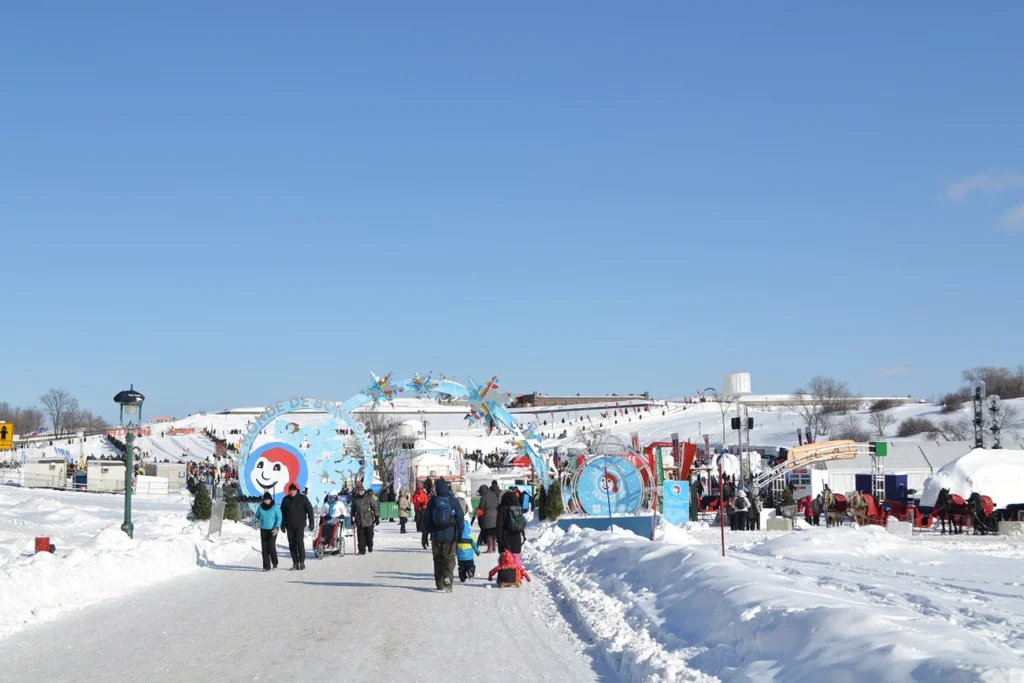
Bonhomme, which is French for “good man” or, in this context, “snowman,” is the official representative of the Carnaval de Québec. The largest winter carnival in the world. He made his first public appearance on January 9, 1955, at the inaugural edition of the modern Carnaval de Québec.
Has led the celebrations every year since. He is identifiable by his redtuque(a traditional Québécois wool cap) and his redceinture fléchée(arrow sash).
Is a traditional garment of French Canadian culture and one of the most recognisable symbols of Québécois identity. On the opening night of each carnival, the mayor of Québec City ceremonially hands over the keys of the city to Bonhomme. Symbolically transferring civic authority to the carnival and its spirit for the duration of the festival.
The gesture has been performed at every carnival since 1955. It reflects something genuine about the relationship between the carnival and the city. During the two weeks of the festival, the carnival is the organising principle of daily life in Québec City.
The Cultural Significance of Bonhomme
For the Québécois people, Bonhomme is not simply a costume or a corporate character. He represents the province’s relationship with winter: rather than enduring the cold, Québec has historically embraced it. Bonhomme is the embodiment of that embrace. The tradition of celebrating winter rather than retreating from it runs deep in Québécois culture and connects to the province’s French colonial heritage.
Communities gathered before Lent to eat, drink, and be together against the cold. Bonhomme carries that tradition into the contemporary festival. It ranks as impolite in Québec to ask about the identity of the person inside the Bonhomme costume. For the Québécois, Bonhomme is not a person in a costume.
He is Bonhomme, a figure with his own history, his own personality. His own place in the cultural life of the province. For French immersion students, this is itself a productive conversation topic. What does it reveal about a culture that a snowman is treated as a genuine public figure rather than a promotional tool? Our Québec City Winter Carnival Tour is built around the Carnaval de Québec and includes the opportunity to meet Bonhomme in person.
The Carnaval de Québec
The Carnaval de Québec, held each February for approximately two weeks. Draws over one million visitors annually and is consistently ranked as one of the largest winter festivals in the world. Its origins trace to the French colonial tradition of celebrating before Lent. Its modern form opened in in 1955 by founders Louis-Philippe Plamondon, Wilbrod Bhérer.
Louis Paré, who recognised the economic potential of transforming a difficult Québec winter into a tourism asset. The events of the carnival include ice canoe races across the semi-frozen St. Lawrence (one of the most physically demanding athletic events in Canada), ice sculpture competitions judged by international artists.
A night parade through the streets of Old Québec, outdoor concerts on the Plains of Abraham. The Ice Palace built fresh each year from ice and snow at a new location with a new theme. The Ice Palace serves as Bonhomme’s official residence during the carnival and is one of the most photographed structures in Québec City during February.
Why It Works for Student Groups
The Carnaval de Québec is one of the most consistently successful student trip destinations in Prométour’s programme for three reasons. First, it provides a fully French-speaking immersion environment in which the language is everywhere and unavoidable. Is exactly what French immersion programmes are preparing students for.
Second, it is genuinely entertaining: the activities are physical, communal, and unfamiliar. Keeps student engagement high in a way that a museum visit may not. Third, the cultural content, what the carnival reveals about Québécois identity, winter culture. The relationship between celebration and hardship, is substantive enough to support a serious curriculum connection.
Hôtel de Glace, adjacent to the Valcartier resort north of Québec City, is a natural addition to a Carnaval itinerary. The hotel is built entirely from ice and snow each winter, with guest rooms, a chapel, an ice bar. Elaborate sculptural installations. A daytime visit without an overnight stay gives students the experience of a fully ice-constructed interior space. Is unlike anything available in their home environment.
Prométour builds fully private school group tours to the Carnaval de Québec. Designed around the festival calendar and the French immersion opportunities that the carnival provides. Browse theQuébec City Winter Carnival Touror the Ottawa. Montréal and Québec City Tour to see what a winter trip to Québec could look like for your group. The curriculum connections and logistical support available make this one of the most rewarding programmes to build.