






Notre-Dame Basilica of Montréal: Art, History, and Identity
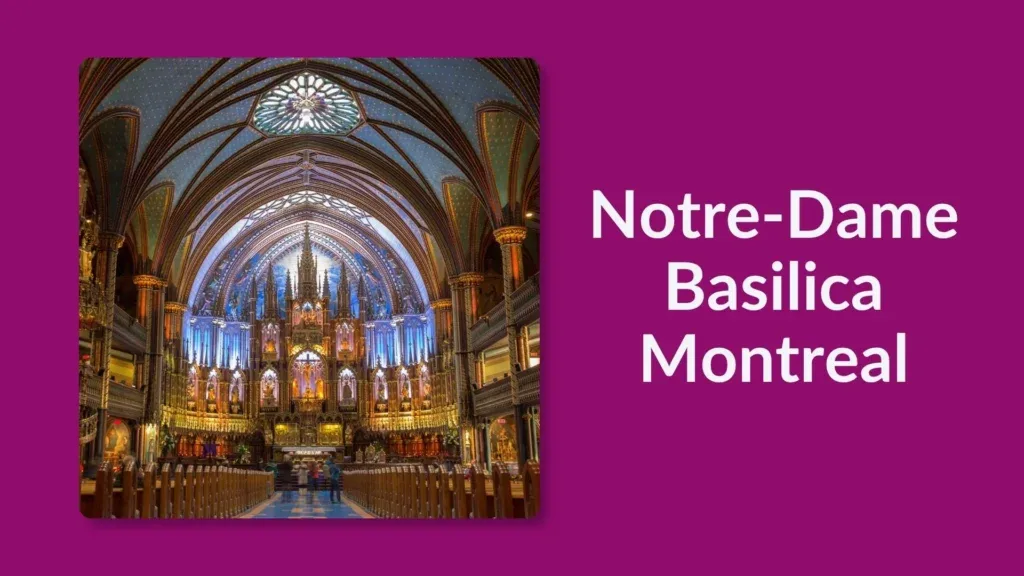
Notre-Dame Basilica of Montréal gives students an immediate visual entry point into the city’s history. Its Gothic Revival architecture, carved interior, stained glass, and location in Old Montréal support discussions about religion, migration, artistic patronage, urban development, and collective identity. A visit becomes more meaningful when students are prepared to read the building as historical evidence rather than simply admire it.
Quick answer: Prométour plans private, custom student trips in Québec that are built around one class and one set of learning goals, so the itinerary, group size, and academic focus fit what a teacher actually needs.
Notre-dame basilica montreal students gives teachers a focused way to connect curriculum goals with authentic experience. Notre-Dame Basilica of Montréal gives students an immediate visual entry point into the city’s history. Its Gothic Revival architecture, carved interior, stained glass, and location in Old Montréal support discussions about religion, migration, artistic patronage, urban development, and collective identity. A visit becomes more meaningful when students are prepared to read the building as historical evidence rather than simply admire it.
Reading architecture as a historical source
The basilica’s scale and decoration communicate the influence of the Catholic Church in nineteenth-century Montréal. Students can observe how materials, height, light, symmetry, and ornament create a sense of authority and ceremony.
Teachers can ask learners to identify design choices that shape emotion. Comparing the exterior with the interior also reveals how a building controls expectations and movement.
Stained glass tells a local story
Unlike windows that focus only on biblical scenes, the basilica’s stained glass includes episodes from Montréal’s religious and civic history. This creates an opportunity to discuss who chooses the stories represented in public monuments.
Students can consider whose experiences are emphasized, what values are communicated, and how historical interpretation changes over time.
Connecting faith, society, and urban growth
The basilica was built when Montréal was expanding as a commercial and cultural centre. Its history helps students examine the relationship between institutions, wealth, community leadership, and city building.
A broader Old Montréal walk can connect the church to nearby banks, public squares, warehouses, and government buildings. Students then see the district as an interconnected historical landscape.
Preparing students for respectful observation
Notre-Dame remains an active place of worship. Students should understand expectations around volume, photography, movement, and scheduled services before entering.
Respectful behaviour is part of the learning outcome. It teaches students how to visit sacred spaces across cultures while remaining attentive to both artistic and living religious significance.
The Interior Is a Designed Argument
Notre-Dame Basilica Montreal students can study the building as more than a collection of beautiful details. Colour, light, carved wood, scale, and iconography work together to create a particular emotional and religious experience. Students can ask how architecture directs attention and how decoration communicates authority.
The basilica also connects to Montréal’s Catholic history, French-speaking institutions, immigration, and urban development. Its changing role helps students examine how a religious landmark functions within a more secular and diverse city.
Slow Looking Produces Better Questions
Instead of trying to identify every feature, assign students one element to observe closely. They might trace repeated symbols, compare lighting zones, sketch a structural detail, or analyze how visitors move through the space. Focused observation leads to stronger interpretation than a rapid list of facts.
A focused visit can connect architecture to the wider story of Montréal and give students a framework they can apply to other historic buildings. Quebec: Montreal Urban Geography Tour offers a practical starting point, and the Québec history tours page can help you compare related options.
The Interior Rewards Slow Looking
Students often enter a major church and respond first to scale and decoration. A structured observation task helps them move beyond that initial reaction. Ask them to select one material, colour, symbol, or architectural feature and explain how it directs attention or communicates meaning.
The basilica also offers a useful discussion about restoration and interpretation. Students can consider how a historic religious space continues to function while also serving as a cultural landmark visited by people with many different beliefs.
A Stronger Classroom Connection
For teachers, the experience becomes most valuable when students know what evidence to look for and how the experience connects to work already completed in class. A focused question, a short observation task, and a purposeful discussion afterward can turn the topic into learning that students can explain in their own words.
For another teacher-focused perspective, read Pointe-à-Callière: Montréal History Beneath the City.
For background research, teachers can consult official sources such as the Notre-Dame Basilica of Montréal and Parks Canada.
Frequently asked questions
What grade levels are Québec student trips suitable for?
Because Prométour builds every itinerary privately for a single group, the pacing and content are set to match the class, from middle-school groups to senior students. A teacher shapes the academic focus, so the same route can serve a beginner language class or an advanced one.
How far ahead should teachers plan Québec student trips?
Most group leaders start nine to twelve months out, which leaves room to confirm dates, fundraise, and align the route with the curriculum. You can request a custom quote and a draft itinerary early, then adjust it as enrolment settles. See the trip page for a starting point.
How does the trip connect to what students study in class?
Each site is chosen to reinforce classroom units, so students meet the primary sources and places behind the textbook. Teachers can request pre-trip and post-trip materials that tie visits back to the curriculum.
Bringing it into the classroom: the strongest Québec trips start from a clear curriculum goal, not a checklist of sights. Decide what you want students to understand in your unit, then let the itinerary serve that goal. A private, custom plan makes that alignment possible, and you can shape it directly on the trip page.