





Germany/AustriaArt & ArchitectureApril 13, 2016 | 5 min read
5 unique Germany Austria attractions you don't want to miss
Germany Austria student attractions can take learning well beyond standard sightseeing. These five experiences connect history, music, architecture, transportation, and local culture with activities students are likely to remember. Deep curriculum connections in history, music, architecture. Social studies. But the experiences students remember longest are rarely the obvious ones.
Here are five that go beyond the standard itinerary and make a trip to these countries genuinely memorable. Germany and Austria offer student trip attractions that go well beyond the standard European itinerary.
Why Germany Austria Student Attractions Stand Out
Cycling is a primary mode of transport in Munich. A guided bike tour of the city gives students a fundamentally different experience of the urban landscape than a walking tour does. The pace is faster, the range is wider. The physical engagement with the city changes how students notice it.
A good local guide can take a group through the English Garden, the medieval Altstadt, the market squares. The quieter residential streets that tourist buses never reach. Munich’s open spaces are generous and genuinely designed for cyclists. Makes the logistics straightforward even for large groups.
For history and social studies teachers, Munich is also one of the most historically layered cities in Germany. The same streets that were home to the Weimar-era beer hall putsch of 1923 are now a cheerful, forward-looking European city. A good guide helps students hold both realities at once. Prométour’s Germany: Classic Tour includes Munich and can be built to include a guided bike tour as part of the city programme.
2. An Evening at a Classical Concert in Vienna
Vienna’s concert calendar is among the densest in the world. Attending a live classical performance in the city where Mozart, Beethoven, Schubert. Brahms all lived and worked gives music students something no recording can provide. The Musikverein, the Staatsoper, and the smaller Kammermusiksaal all offer student pricing.
Several venues run concert series specifically designed for younger audiences. For music teachers, a Vienna concert is a direct curriculum connection to the classical and Romantic periods. For any group, it is an evening that tends to produce a visible shift in how students relate to music they may have previously found remote. Our Austria: Music Tour is built specifically around Vienna’s musical heritage and can incorporate a live performance as an evening programme.
3. A Visit to the Documentation Centre of the Nazi Party Rally Grounds, Nuremberg
The Documentation Centre at the former Nazi Party rally grounds in Nuremberg is one of the most sobering and educationally substantive sites in Europe. The permanent exhibition, housed in the unfinished Congress Hall that Albert Speer designed for the rallies. Traces the rise of National Socialism, the mechanics of propaganda.
The events that led to the Nuremberg Trials held in the adjacent courthouse. The scale of the rally grounds. You can walk through, makes the ambition of the Nazi programme physically legible in a way that photographs do not capture. For history teachers, Nuremberg is a site of singular importance. The trials that took place there established the legal framework for international criminal law that still governs war crimes prosecution today.
4. The Dachau Memorial Site
Located 16 kilometres northwest of Munich, the Dachau Concentration Camp Memorial Site occupies the grounds of the first concentration camp established by the Nazi regime in 1933. Today, the site is a memorial and museum with reconstructed barracks, the original gatehouse, and exhibitions covering the camp’s history from 1933 to 1945.
Memorials built by survivor communities. For secondary history students studying WWII and the Holocaust, Dachau is among the most visited and best-documented memorial sites in Germany. Teachers consistently describe it as one of the most affecting experiences of any trip to Europe. One that students approach with a seriousness that transfers back into classroom work. A visit requires careful preparation and a structured debrief, both of which Prométour can help you plan.
5. Salzburg’s Sound of Music Tour
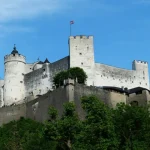
The Sound of Music is set in Salzburg. The locations used in the 1965 film are genuine landmarks of the city and its surrounding countryside. The Mirabell Gardens, the Nonnberg Abbey, the Leopoldskron Palace. The Alpine landscapes of the Salzkammergut region. A guided Sound of Music tour is a reliable crowd-pleaser for student groups.
It is also more educationally substantive than it sounds. The film’s historical backdrop, the annexation of Austria by Nazi Germany in 1938, connects directly to a WWII curriculum. The Baroque and Rococo architecture of Salzburg’s old city, a UNESCO World Heritage Site. Gives art and architecture teachers substantial material. And the city’s connection to Mozart, who came into the world there in 1756, anchors the music curriculum. OurAustria: Music Tourspends significant time in Salzburg and can incorporate the Sound of Music locations as part of the itinerary.
Prométour builds fully private, custom school group tours to Germany and Austria designed around your curriculum and your students. Browse theGermany: Classic Tour, Germany: Adventure Tour. OrAustria: Music Tourto see what a customised itinerary could look like for your group. For teachers planning a germany austria student trip attractions, the curriculum connections and logistical support available make this one of the most rewarding programmes to build.